2.11. Custom Presumed PDF: log-mean PDF of the scalar dissipation rate
This demo is part of Spitfire, withlicensing and copyright info here.
Highlights - Building presumed PDF adiabatic and nonadiabatic SFLM
libraries for turbulent flows - Using Spitfire’s wrapper around the
Python interface of
`TabProps <https://multiscale.utah.edu/software/>`__ to easily
extend tables with clipped Gaussian and Beta PDFs
Tabulated chemistry models can often be split into two pieces: a reaction model and a mixing model. The reaction model describes small scale laminar flame structure, for instance equilibrium (fast chemistry) or diffusion-reaction (SLFM), possibly perturbed by radiative heat losses. A mixing model is unnecessary in a CFD simulation when the flow is laminar or when all scales of turbulence are resolved as in direct numerical simulation (DNS). In Reynolds-averaged Navier-Stokes (RANS) or large eddy simulation (LES), however, small scales are modeled instead of being resolved by the mesh. Here a mixing model is necessary to account for turbulence-chemistry interaction on subgrid scales.
In RANS and LES, typically two statistical moments of conserved scalars are transported on the mesh and the mixing model accounts for unresolved, or subgrid, heterogeneity. A mixing model accomplishes this by describing the statistical distribution of the subgrid scalar field. Spitfire and the Python interface of the ``TabProps` code <https://multiscale.utah.edu/software/>`__ can be combined to build reaction models and then incorporate presumed PDF mixing models.
2.11.1. Reaction Model
We’ll start by building a standard adiabatic SLFM library for an
n-heptane/air mixture, except in this case we’ll specify a very wide
range of the stoichiometric dissipation rate and set
include_extinguished=True to keep non-burning states after
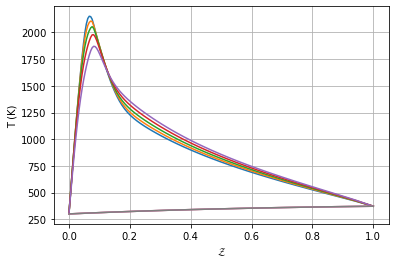
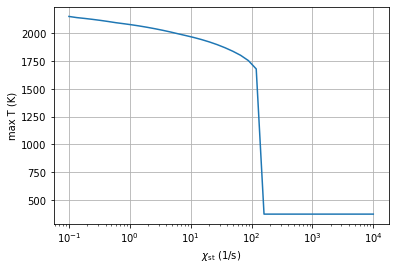
extinction in the library. You can verify this with the plots below,
where the discontinuity of extinction is clear.
from spitfire import (ChemicalMechanismSpec,
                      FlameletSpec,
                      build_adiabatic_slfm_library,
                      apply_mixing_model,
                      PDFSpec,
                      Library)
import matplotlib.pyplot as plt
from matplotlib.colors import Normalize
import numpy as np

mech = ChemicalMechanismSpec(cantera_xml='heptane-liu-hewson-chen-pitsch-highT.xml',
                             group_name='gas')

flamelet_specs = FlameletSpec(mech_spec=mech,
                              initial_condition='equilibrium',
                              oxy_stream=mech.stream(stp_air=True),
                              fuel_stream=mech.stream('TPY', (372., 101325., 'NXC7H16:1')),
                              grid_points=64)

slfm = build_adiabatic_slfm_library(flamelet_specs,
                                    diss_rate_values=np.logspace(-1, 4, 40),
                                    diss_rate_ref='stoichiometric',
                                    include_extinguished=True,
                                    verbose=False)

plt.plot(slfm.mixture_fraction_values, slfm['temperature'][:, ::5])
plt.xlabel('$\\mathcal{Z}$')
plt.ylabel('T (K)')
plt.grid()
plt.show()
plt.semilogx(slfm.dissipation_rate_stoich_values, np.max(slfm['temperature'], axis=0),
             '-', markersize=2)
plt.xlabel('$\\chi_{\\rm st}$ (1/s)')
plt.ylabel('max T (K)')
plt.grid()
plt.show()
plt.contourf(slfm.mixture_fraction_grid,
             slfm.dissipation_rate_stoich_grid,
             slfm['temperature'])
plt.yscale('log')
plt.xlabel('$\\mathcal{Z}$')
plt.ylabel('$\\chi_{\\rm st}$ (1/s)')
plt.title('laminar flamelet T(K)')
plt.colorbar()
plt.show()

2.11.2. The User-Defined PDF Class
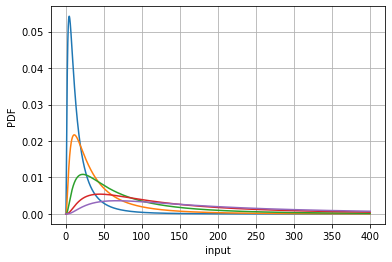
Here we use a one-parameter logarithmic mean PDF for the dissipation rate (in addition to a clipped Gaussian PDF for the scalar variance). The class below defines several key methods, some of which are required for the integration in Spitfire.
set_mean(self, mean): necessary API for Spitfire’s PDF integration.set_variance(self, variance)/set_scalar_variance(self, variance): one of these is needed, even though there isn’t a variance in this PDF, as Spitfire will internally call one of the two methods depending on which ofvariance_valuesorscalar_variance_valuesis provided as an argument toapply_mixing_model.integrate(self, interpolant): necessary for the internal API, which will provide a 1D interpolant with a call operator. The integrand being integrated must be the PDF multiplied by the interpolant. Here we simply use Simpson’s rule as the log mean PDF seems pretty simple to integrate. In general, adaptive quadrature should be used to guarantee accurate results.get_pdf(self, x): completely unnecessary for integration with the PDF, but convenient for visualization
from scipy.integrate import simpson

class LogMean1ParamPDF:
    def __init__(self, sigma):
        self._sigma = sigma
        self._mu = 0.
        self._s2pi = np.sqrt(2. * np.pi)
        self._xt = np.logspace(-6, 6, 1000)
        self._pdft = np.zeros_like(self._xt)

    def get_pdf(self, x):
        s = self._sigma
        m = self._mu
        return 1. / (x * s * self._s2pi) * np.exp(-(np.log(x) - m) * (np.log(x) - m) / (2. * s * s))

    def set_mean(self, mean):
        self._mu = np.log(mean) - 0.5 * self._sigma * self._sigma
        self._pdft = self.get_pdf(self._xt)

    def set_variance(self, variance):
        pass

    def set_scaled_variance(self, variance):
        raise ValueError('cannot use set_scaled_variance on LogMean1ParamPDF, use direct variance values')

    def integrate(self, interpolant):
        ig = interpolant(self._xt) * self._pdft
        return simpson(ig, x=self._xt)

lm_pdf = LogMean1ParamPDF(1.0)

xtest = np.logspace(-3, np.log10(400), 10000)

for mean in [20., 50., 100.0, 200, 300]:
    lm_pdf.set_mean(mean)
    plt.plot(xtest, lm_pdf.get_pdf(xtest))
plt.grid()
plt.xlabel('input')
plt.ylabel('PDF')
plt.show()
2.11.3. Integrating the Custom PDF
Now we simply provide our instance of the class, lm_pdf, as the
pdf argument to the PDFSpec for apply_mixing_model. We just
set a single variance_value here because we’re not actually adding
an entire range of variances with the one-parameter log-mean PDF. Also,
note that the set_variance() method on the class above doesn’t
actually use the value, which is just set to 1. for simplicity.
An important consequence of only specifying a single variance or scaled
variance value is that the resultant library will be squeezed so
that no additional dimensions are actually added. You can see this below
when we print the library - it doesn’t have a
dissipation_rate_stoich_variance_mean dimension.
# remove the mass fractions to speed up the convolution integrals - we're only observing the temperature here
mass_fracs = slfm.props
mass_fracs.remove('temperature')
slfm.remove(*mass_fracs)

slfm_t = apply_mixing_model(
    slfm,
    verbose=True,
    mixing_spec={'dissipation_rate_stoich': PDFSpec(pdf=lm_pdf, variance_values=np.array([1.])),
                 'mixture_fraction': PDFSpec(pdf='ClipGauss', scaled_variance_values=np.linspace(0, 1, 8))},
    num_procs=4
    )

print(slfm_t)
dissipation_rate_stoich_variance: computing 2560 integrals... completed in 1.1 seconds, average = 2374 integrals/s.
scaled_scalar_variance_mean: computing 20480 integrals... completed in 4.5 seconds, average = 4562 integrals/s.

Spitfire Library with 3 dimensions and 1 properties
------------------------------------------
1. Dimension "mixture_fraction_mean" spanning [0.0, 1.0] with 64 points
2. Dimension "dissipation_rate_stoich_mean" spanning [0.1, 10000.0] with 40 points
3. Dimension "scaled_scalar_variance_mean" spanning [0.0, 1.0] with 8 points
------------------------------------------
temperature         , min = 299.99991531427054 max = 2144.707709229305
Extra attributes: {'mech_spec': <spitfire.chemistry.mechanism.ChemicalMechanismSpec object at 0x7f8b4393ee10>, 'mixing_spec': {'dissipation_rate_stoich': <spitfire.chemistry.tabulation.PDFSpec object at 0x7f8b3d2935d0>, 'mixture_fraction': <spitfire.chemistry.tabulation.PDFSpec object at 0x7f8b3d293590>}}
------------------------------------------
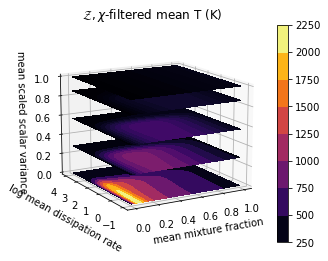
2.11.4. Visualizing the Result
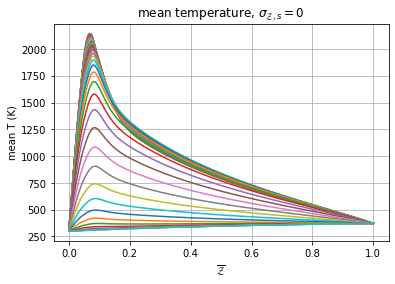
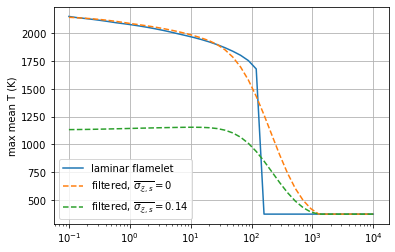
Now we finish up with some plots. Note especially the effect filtering the dissipation rate has on the max temperature plot - we’ve actually smoothed the extinction behavior over a much larger range of the mean dissipation rate.
plt.plot(slfm_t.mixture_fraction_mean_values, np.squeeze(slfm_t['temperature'][:, :, 0]))
plt.xlabel('$\\overline{\\mathcal{Z}}$')
plt.ylabel('mean T (K)')
plt.title('mean temperature, $\\sigma_{\\mathcal{Z},s}=0$')
plt.grid()
plt.show()
plt.semilogx(slfm.dissipation_rate_stoich_values, np.max(slfm['temperature'], axis=0),
             '-', markersize=2, label='laminar flamelet')
plt.semilogx(slfm_t.dissipation_rate_stoich_mean_values, np.max(slfm_t['temperature'], axis=0)[:, 0],
             '--', markersize=2, label='filtered, $\\overline{\\sigma_{\\mathcal{Z},s}}=0$')
plt.semilogx(slfm_t.dissipation_rate_stoich_mean_values, np.max(slfm_t['temperature'], axis=0)[:, 1],
             '--', markersize=2, label='filtered, $\\overline{\\sigma_{\\mathcal{Z},s}}=0.14$')
plt.ylabel('$\\overline{\\chi_{\\rm st}}$ (1/s)')
plt.ylabel('max mean T (K)')
plt.grid()
plt.legend()
plt.show()
plt.contourf(np.squeeze(slfm_t.mixture_fraction_mean_grid[:, :, 0]),
             np.squeeze(slfm_t.dissipation_rate_stoich_mean_grid[:, :, 0]),
             np.squeeze(slfm_t['temperature'][:, :, 0]),
             norm=Normalize(slfm_t['temperature'].min(), slfm_t['temperature'].max()))
plt.colorbar()
plt.yscale('log')
plt.xlabel('$\\overline{\\mathcal{Z}}$')
plt.ylabel('$\\overline{\\chi_{\\rm st}}$ (1/s)')
plt.title('mean T (K) at $\\overline{\\sigma_{\\mathcal{Z},s}}=0$')
plt.show()
plt.contourf(np.squeeze(slfm_t.mixture_fraction_mean_grid[:, :, 0]),
             np.squeeze(slfm_t.dissipation_rate_stoich_mean_grid[:, :, 0]),
             np.squeeze(slfm_t['temperature'][:, :, 1]),
             norm=Normalize(slfm_t['temperature'].min(), slfm_t['temperature'].max()))
plt.colorbar()
plt.yscale('log')
plt.xlabel('$\\overline{\\mathcal{Z}}$')
plt.ylabel('$\\overline{\\chi_{\\rm st}}$ (1/s)')
plt.title('mean T (K) at $\\overline{\\sigma_{\\mathcal{Z},s}}=0.14$')
plt.show()


from mpl_toolkits.mplot3d import axes3d
from matplotlib.colors import Normalize
fig = plt.figure()
ax = fig.gca(projection='3d')
z = np.squeeze(slfm_t.mixture_fraction_mean_grid[:, :, 0])
x = np.squeeze(np.log10(slfm_t.dissipation_rate_stoich_mean_grid[:, :, 0]))
v_list = slfm_t.scaled_scalar_variance_mean_values
for idx in [7, 6, 4, 2, 0]:
    p = ax.contourf(z, x, np.squeeze(slfm_t['temperature'][:, :, idx]),
                    offset=v_list[idx],
                    cmap='inferno',
                    norm=Normalize(300, 2200))
plt.colorbar(p)
ax.view_init(elev=14, azim=-120)
ax.set_zlim([0, 1])
ax.set_xlabel('mean mixture fraction')
ax.set_ylabel('log mean dissipation rate')
ax.set_zlabel('mean scaled scalar variance')
ax.set_title('$\\mathcal{Z},\chi$-filtered mean T (K)')
plt.show()