4.2.2. Explicit time integration with user-defined methods
This demo is part of Spitfire, with licensing and copyright info here.
Highlights
solving ordinary differential equations with your own methods
custom eighth-order Runge-Kutta method
coding up a second-order Adams-Bashforth method for use in Spitfire
4.2.2.1. Introduction
In previous demonstrations you’ve seen the basics of using Spitfire’s
odesolve method. The abstraction of time integration techniques in
odesolve makes it possible for you to “plug in” methods defined
entirely in your own code, which is the focal point of this notebook.
Two ways of building your own time-stepping methods are covered: 1.
Using the GeneralAdaptiveERK class in spitfire.time.methods to
provide Butcher coefficients for general, explicit Runge-Kutta methods
(possibly with error-based adaptive time-stepping) 2. Writing your own
Method classes for a Governor instance
We will use the first option to build some Runge-Kutta methods, and we will show how the second method can actually enable the use of Adams-Bashforth methods not provided by Spitfire.
4.2.2.2. Custom Runge-Kutta methods with GeneralAdaptiveERK
This class allows you to define the Butcher tableau for any explicit Runge-Kutta method. Below we first build the Forward Euler method and then a more interesting example - the two-stage, second-order method of Ralston.
import numpy as np
from spitfire import GeneralAdaptiveERK as GERK

runge_kutta_methods = dict()

runge_kutta_methods['Forward Euler'] = GERK(name='Forward Euler',
                                            A=np.array([[0.]]),
                                            b=np.array([1.]),
                                            order=1)
runge_kutta_methods['Ralston'] = GERK(name='Ralston',
                                      A=np.array([[0., 0.],
                                               [2. / 3., 0.]]),
                                      b=np.array([0.25, 0.75]),
                                      order=2)
Just for some extra fun we now make an eighth-order method with thirteen stages.
runge_kutta_methods['Fehlberg'] = GERK(name='Fehlberg',
                                       A=np.array([[0, 0, 0, 0, 0, 0, 0, 0, 0, 0, 0, 0, 0],
                                                   [2. / 27., 0, 0, 0, 0, 0, 0, 0, 0, 0, 0, 0, 0],
                                                   [1. / 36., 1. / 12., 0, 0, 0, 0, 0, 0, 0, 0, 0, 0, 0],
                                                   [1. / 24, 0, 1. / 8, 0, 0, 0, 0, 0, 0, 0, 0, 0, 0],
                                                   [5. / 12., 0, -25. / 16., 25. / 16., 0, 0, 0, 0, 0, 0, 0, 0, 0],
                                                   [1. / 20., 0, 0, 1. / 4., 1. / 5., 0, 0, 0, 0, 0, 0, 0, 0],
                                                   [-25. / 108, 0, 0, 125. / 108., -65. / 27., 125. / 54., 0, 0, 0, 0, 0, 0, 0],
                                                   [31. / 300., 0, 0, 0, 61. / 225., -2. / 9., 13. / 900., 0, 0, 0, 0, 0, 0],
                                                   [2., 0, 0, -53. / 6., 704. / 45., -107. / 9., 67. / 90., 3., 0, 0, 0, 0, 0],
                                                   [-91. / 108., 0, 0, 23. / 108., -976. / 135., 311. / 54., -19. / 60., 17. / 6., -1. / 12., 0, 0, 0, 0],
                                                   [2383. / 4100., 0, 0, -341. / 164., 4496. / 1025., -301. / 82., 2133. / 4100., 45. / 82., 45. / 164., 18. / 41., 0, 0, 0],
                                                   [3. / 205., 0, 0, 0, 0, -6. / 41., -3. / 205., -3. / 41., 3. / 41., 6. / 41., 0, 0, 0],
                                                   [-1777. / 4100., 0, 0, -341. / 164., 4496. / 1025., -289. / 82., 2193. / 4100., 51. / 82., 33. / 164., 12. / 41., 0, 1., 0]]),
                                       b=np.array([0, 0, 0, 0, 0, 34. / 105., 9. / 35., 9. / 35., 9. / 280., 9. / 280., 0, 41. / 840., 41. / 840.]),
                                       order=8)
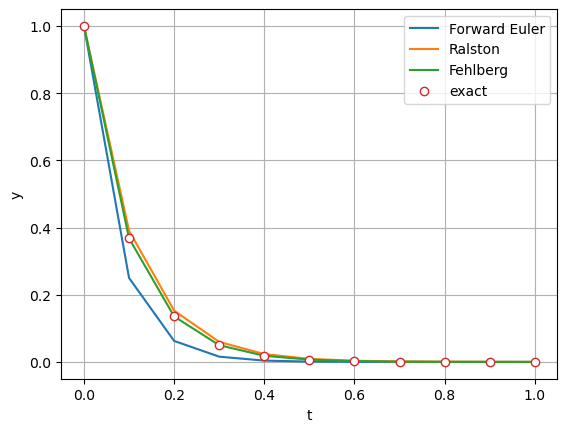
Now we can go ahead and solve the exponential decay problem from prior notebooks with each method. Note how accurate the eighth-order method is compared to Forward Euler and the Ralston method.
from spitfire import odesolve

import matplotlib.pyplot as plt

dt = 0.05
k = -10.
tf = 1.
y0 = np.array([1.])
rhs = lambda t, y: k * y

output_times = np.linspace(0., tf, 11)
y_exact = y0 * np.exp(k * output_times)

for name in runge_kutta_methods:
    y = odesolve(rhs, y0, output_times, step_size=dt, method=runge_kutta_methods[name])
    plt.plot(output_times, y, '-', label=name)

plt.plot(output_times, y_exact, 'o', markerfacecolor='w', label='exact')

plt.xlabel('t')
plt.ylabel('y')
plt.legend(loc='best')
plt.grid()
plt.show()
4.2.2.3. Adams-Bashforth method with a custom class
Now we show how to write a new method that can be used in odesolve.
Spitfire doesn’t provide linear multistep methods out of the box, but we
can code up the second-order Adams-Bashforth method in twenty or so
lines. Our class derives from the TimeStepperBase class, to which it
provides its name and order of accuracy in the super().__init__ call
(a base class constructor in Python). Next, the single_step method
is defined and written so that it returns a StepOutput object
populated with the solution update (\(y^{n+1}-y^{n}\)). And that’s
it.
The second-order Adams-Bashforth method, referred to frequently as AB2, is a two-step method that uses the right-hand side at both the current time level and the prior one. The next time level, with solution \(y^{n+1}\), is computed with
where \(r(t,y)\) is the right-hand side function of the differential equation. This update can’t be performed on the first time step and so we simply use the Forward Euler update \(y^{n+1} = y^{n} + \Delta t r(t^n, y^n)\). This is not strictly accurate to second-order, but it works well enough in practice.
A key detail in implementing linear multistep methods is the challenge of handling a variable time step history. We simply ignore this difficulty here, so the class below will only be correct for a fixed time step. We’ll actually implement a variable step AB2 method in a following demonstration.
Note that custom time-stepper methods like this can return more
information in StepOutput, such as error estimates for time step
adaptativity, but that’s a bit more advanced and we suggest interested
developers check out the source code in the spitfire.time.methods.py
file for more details.
from spitfire.time.methods import StepOutput, TimeStepperBase

class AdamsBashforth2(TimeStepperBase):
    def __init__(self):
        super().__init__(name='Adams-Bashforth-2', order=2)
        self._rhs_nm1 = None

    def single_step(self, state, t, dt, rhs, *args, **kwargs):
        rhs_n = rhs(t, state)
        if self._rhs_nm1 is None:
            update = dt * rhs_n   # if first step, use Forward Euler
        else:
            update = 0.5 * dt * (3. * rhs_n - self._rhs_nm1)
        self._rhs_nm1 = np.copy(rhs_n)
        return StepOutput(solution_update=update)
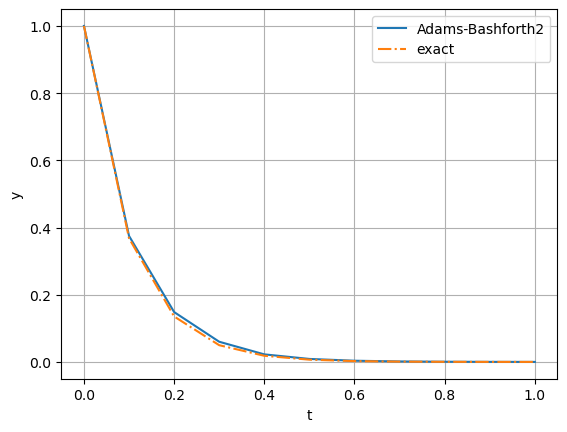
Now this class may simply be provided to odesolve like any of the
other methods we’ve used so far.
y_ab2 = odesolve(rhs, y0, output_times, step_size=dt, method=AdamsBashforth2())

plt.plot(output_times, y_ab2, '-', label='Adams-Bashforth2')
plt.plot(output_times, y_exact, '-.', label='exact')

plt.xlabel('t')
plt.ylabel('y')
plt.legend(loc='best')
plt.grid()
plt.show()
4.2.2.4. Verification
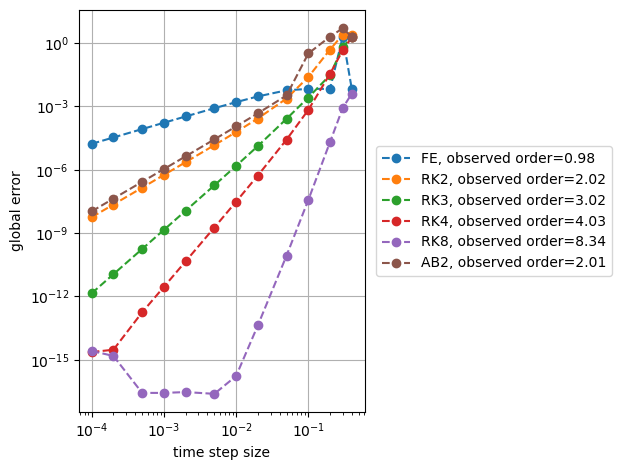
To make sure that we coded our new Adams-Bashforth method correctly, we’re going to verify by establishing its order of accuracy. This consists of running simulations at different time step sizes and observing how the error (against an exact solution) decreases. A first-order method will see a 10x decrease in error for a 10x decrease in the step size, while a second-order method would see a 100x decrease and a fourth order method would see a 10000x decrease.
To simplify this we define the compute_error method below that takes
in a time-stepper method and a step size and returns the error in
solving the exponential decay problem to a specified time.
def compute_error(method, time_step_size):
    tf = 0.5
    yf = odesolve(rhs, y0, np.array([tf]), step_size=time_step_size, method=method).ravel()
    return np.abs(yf - y0 * np.exp(k * tf))[0]
Now we import a few more methods provided by Spitfire for comparison’s
sake and run compute_error for each method across a range of time
step sizes. This uses a Python list comprehension to simplify the
construction of the list of errors, and simply saves off the results in
a dictionary. This sort of pattern is really convenient in many uses of
Spitfire.
Following this we use NumPy’s polyfit function to obtain the slopes
of the error over time step size results (in logarithmic scale). This
shows that Spitfire’s methods and our new second-order Adams-Bashforth
method are all solving the problem to their design order of accuracy.
from spitfire import ForwardEulerS1P1, \
    RK4ClassicalS4P4, \
    ExpRalstonS2P2, \
    RK3KuttaS3P3

dt_list = [1e-4, 2e-4, 5e-4, 1e-3, 2e-3, 5e-3, 1e-2, 2e-2, 5e-2, 1e-1, 2e-1, 3e-1, 4e-1]

error_dict = dict()
error_dict['FE'] = [compute_error(ForwardEulerS1P1(), dt) for dt in dt_list]
error_dict['RK2'] = [compute_error(ExpRalstonS2P2(), dt) for dt in dt_list]
error_dict['RK3'] = [compute_error(RK3KuttaS3P3(), dt) for dt in dt_list]
error_dict['RK4'] = [compute_error(RK4ClassicalS4P4(), dt) for dt in dt_list]
error_dict['RK8'] = [compute_error(runge_kutta_methods['Fehlberg'], dt) for dt in dt_list]
error_dict['AB2'] = [compute_error(AdamsBashforth2(), dt) for dt in dt_list]

order_dict = dict()
for method in error_dict:
    # here we slice the results so that the polyfit is done only on the asymptotic data,
    # - some of the methods are unstable with dt > 0.1
    # - the RK8 method and RK4 method reach machine precision errors that cannot be lower
    if method == 'RK8':
        s = slice(6, 10, None)
    else:
        s = slice(2, 7, None)
    order_dict[method] = np.polyfit(np.log(dt_list[s]), np.log(error_dict[method][s]), 1)[0]

for method in error_dict:
    plt.loglog(dt_list, error_dict[method], 'o--', label=f'{method}, observed order={order_dict[method]:.2f}')
plt.legend(bbox_to_anchor=(1.04,0.5), loc="center left", borderaxespad=0)
plt.xlabel('time step size')
plt.ylabel('global error')
plt.grid()
plt.tight_layout()
plt.show()
4.2.2.5. Conclusions
In this example we’ve shown how to employ user-defined explicit Runge-Kutta methods and custom classes, in this a second-order Adams-Bashforth method, to solve a simple ordinary differential equation. Verifying the order of accuracy of the methods suggests confidence that they are implemented correctly.